The Age of the Infovore by Tyler Cowen
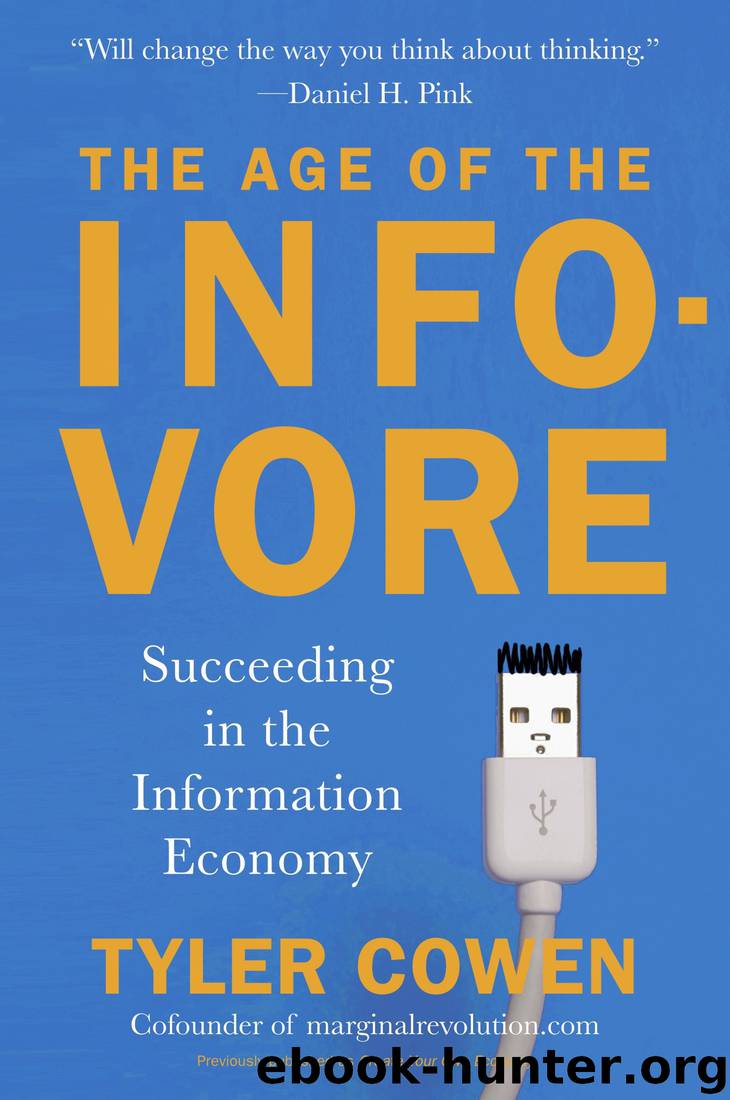
Author:Tyler Cowen [Cowen, Tyler]
Language: eng
Format: epub, mobi
Publisher: Penguin Group US
Published: 2010-06-28T22:00:00+00:00
Those are the goods that are most profitable to market and sell. The direct corollary is that we will be bombarded with stories about the importance of these goods. Coke: the real thing. Finger-lickin’ good (Kentucky Fried Chicken). Please don’t squeeze the Charmin. And so on. In other words, you get stories that are bundled with these goods. It’s the stories that help you get addicted to these goods and to their associated images.
As I’ve noted, addiction isn’t always a bad thing, especially if you’re having fun and the habit isn’t destructive. If you’ve grown attached to eating healthy Rainier cherries (as I have, and in case you don’t know, those are the yellow ones), that’s fine, albeit a bit expensive. But still, the addictive goods promoted by advertisers are not exactly the best choices for you either. The world is sending you stories with a skewed perspective. Because of the influence of ads and popular culture, there is a risk that our personal narratives can become too aspirational, too commercial, and too linked to specific brands. We are also too susceptible to government propaganda.
Autistic people have some cognitive strengths to help them deal with those problems. The love of information found among autistic people meets only the first criterion on the above list, namely it may be addictive. Many ways in which autistics engage with information just don’t yield that much profit to suppliers, precisely because the relevant processes of mental ordering are such cheap pleasures. Most instances of autistic mental ordering don’t need to be linked to scarce and possibly expensive social status goods. The ordering is very often an extreme form of what economists call “household production” and so these pleasures cannot easily be controlled, manipulated, or owned by outside forces. That gives many autistics one kind of freedom from the pressures of commercial society.
Autistics may not seem like such a powerful group, but their techniques of information engagement embody a threat to capitalist marketing as we know it, and I mean that in the best sense. Why buy an expensive brand repeatedly when you can make your own economy in your head? As the evolution of the web illustrates, other people are catching up to this insight and producing more value by their own mental ordering and enjoying that value in their minds, without the intermediation of many expensive commodities. When it comes to protecting yourself against external manipulation by advertisers, a preoccupation with mental ordering is often an underappreciated advantage.
The Portuguese author Fernando Pessoa hit on a fundamental reality: “Wise is the man who monotonizes his existence, for then each minor incident seems a marvel. A hunter of lions feels no adventure after the third lion. For my monotonous cook, a fist-fight on the street always has something of a modest apocalypse…The man who has journeyed all over the world can’t find any novelty in five thousand miles, for he finds only new things—yet another novelty, the old routine of the forever new—while his abstract concept of novelty got lost at sea after the second new thing he saw.
Download
This site does not store any files on its server. We only index and link to content provided by other sites. Please contact the content providers to delete copyright contents if any and email us, we'll remove relevant links or contents immediately.
| Anthropology | Archaeology |
| Philosophy | Politics & Government |
| Social Sciences | Sociology |
| Women's Studies |
Cecilia; Or, Memoirs of an Heiress — Volume 1 by Fanny Burney(32558)
The Great Music City by Andrea Baker(32018)
Cecilia; Or, Memoirs of an Heiress — Volume 2 by Fanny Burney(31956)
Cecilia; Or, Memoirs of an Heiress — Volume 3 by Fanny Burney(31940)
We're Going to Need More Wine by Gabrielle Union(19045)
All the Missing Girls by Megan Miranda(16023)
Pimp by Iceberg Slim(14506)
For the Love of Europe by Rick Steves(14121)
Bombshells: Glamour Girls of a Lifetime by Sullivan Steve(14073)
Talking to Strangers by Malcolm Gladwell(13370)
Norse Mythology by Gaiman Neil(13363)
Fifty Shades Freed by E L James(13239)
Mindhunter: Inside the FBI's Elite Serial Crime Unit by John E. Douglas & Mark Olshaker(9339)
Crazy Rich Asians by Kevin Kwan(9290)
The Lost Art of Listening by Michael P. Nichols(7506)
Enlightenment Now: The Case for Reason, Science, Humanism, and Progress by Steven Pinker(7311)
The Four Agreements by Don Miguel Ruiz(6763)
Bad Blood by John Carreyrou(6621)
Weapons of Math Destruction by Cathy O'Neil(6279)
